

What Is a Recruitment Funnel?
A recruitment funnel is the series of stages candidates pass through — from first hearing about your job opening to accepting your offer. Like a sales funnel, it narrows at each stage as candidates are filtered out.
Understanding your funnel tells you:
- Where candidates drop off — and whether that is a process problem or a quality problem
- How many applicants you need to make one hire
- Which stages are bottlenecks slowing down your entire process
- How effective your sourcing is — whether you are attracting the right candidates from the right channels
Without funnel visibility, hiring feels like guesswork. With it, you can make data-driven decisions that save time and improve hire quality.
The 6 Stages of a Recruitment Funnel
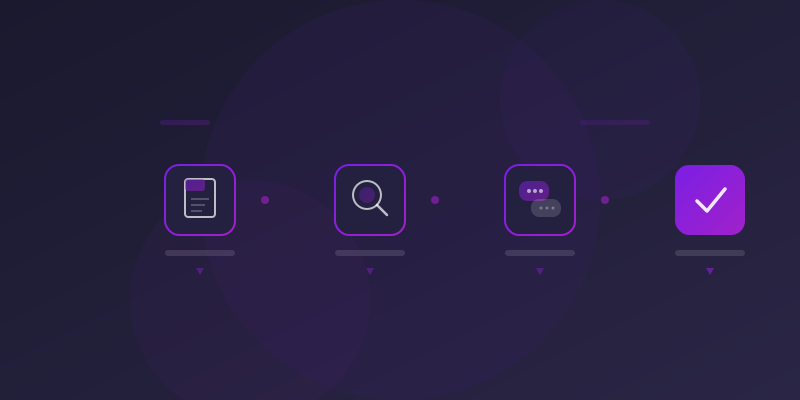
1. Awareness
Candidates become aware that your company exists and is hiring. This happens through job boards, social media, your careers page, employee referrals, and employer branding.
Key question: Are enough qualified people seeing your job openings?
2. Application
Interested candidates submit an application. The conversion from awareness to application depends on your job posting quality, application length, and employer brand.
Key question: Are candidates who see your job actually completing the application?
3. Screening
You review applications and filter out candidates who do not meet basic qualifications. This can be manual, automated, or AI-assisted.
Key question: Are you efficiently identifying qualified candidates without creating a bottleneck?
4. Interview
Qualified candidates go through one or more interview rounds. Each round evaluates different competencies — skills, culture fit, leadership, etc.
Key question: Are your interviews effectively predicting job performance?
5. Offer
You extend an offer to your top candidate. This stage includes salary negotiation, reference checks, and any final approvals.
Key question: Are candidates accepting your offers, or losing interest during this stage?
6. Hire
The candidate accepts and joins your team. The funnel does not truly end here — onboarding quality affects early retention, which reflects back on hiring quality.
Key question: Are your hires succeeding in the role, or is there a pattern of early turnover?
Try BorovaHR Free — No Credit Card Needed
Post jobs, screen candidates with AI, and hire faster. Set up in under 10 minutes.
Get Started FreeKey Metrics to Track at Each Stage
Every stage of your funnel produces data. Here are the metrics that actually matter:
| Stage | Metric | What It Tells You |
|---|---|---|
| Awareness | Job views / impressions | Whether your job postings are reaching enough people |
| Application | Application completion rate | Whether your application process is too long or broken |
| Application | Applications per source | Which channels produce the most candidates |
| Screening | Screen-to-interview ratio | Quality of incoming applications and effectiveness of screening |
| Screening | Time-in-screening | Whether screening is a bottleneck |
| Interview | Interview-to-offer ratio | How many interviews it takes to find a hireable candidate |
| Interview | Candidate drop-off rate | Whether candidates are withdrawing due to slow or poor process |
| Offer | Offer acceptance rate | Competitiveness of your offers and candidate experience |
| Overall | Time-to-hire | Total speed of your hiring process |
| Overall | Cost-per-hire | Total investment to fill a position |
| Overall | Quality of hire | Performance and retention of new hires (lagging metric) |
Benchmark Conversion Rates
Knowing your conversion rates at each stage tells you whether your funnel is healthy. Here are typical benchmarks for small to mid-sized companies:
| Stage Transition | Typical Rate | Good Rate |
|---|---|---|
| Job view to application | 8-12% | 15%+ |
| Application to screen pass | 15-25% | 30%+ |
| Screen to interview | 40-60% | 60%+ |
| Interview to offer | 15-30% | 30%+ |
| Offer to hire | 70-85% | 90%+ |
What the Numbers Mean
- Low job-view-to-application rate — Your job posting is not compelling or your application process is too long
- Low application-to-screen rate — You are attracting unqualified candidates. Review where you are posting and how you describe the role
- Low screen-to-interview rate — Your screening criteria may be too strict, or screening is creating a bottleneck
- Low interview-to-offer rate — Your interviews are not aligned with what you are screening for, or interview quality is poor
- Low offer-to-hire rate — Your offers are not competitive, you are too slow, or candidate experience is pushing people away
Try BorovaHR Free — No Credit Card Needed
Post jobs, screen candidates with AI, and hire faster. Set up in under 10 minutes.
Get Started FreeHow to Optimize Your Recruitment Funnel
Once you have data, here is how to improve each stage:
Top of Funnel: Get More Qualified Applicants
- Write better job descriptions with clear requirements and salary ranges
- Post on niche job boards where your target candidates actually look
- Build an employee referral program — referrals typically convert at 2-3x the rate of job board applicants
- Optimize your careers page for mobile and speed
Middle of Funnel: Screen and Interview Efficiently
- Use AI-powered screening to reduce time-in-screening from days to hours
- Implement structured interviews with scorecards to improve consistency
- Reduce unnecessary interview rounds — every round adds days and increases drop-off
- Pre-schedule interview slots so there is no back-and-forth delay
Bottom of Funnel: Close More Offers
- Make decisions within 48 hours of the final interview
- Call candidates with the offer before sending a formal letter
- Benchmark your compensation against market rates
- Keep communication warm between offer and start date to prevent "offer regret"
BorovaHR gives you full funnel visibility with built-in analytics, so you can see exactly where candidates drop off and take action to fix it.
Source Quality: Not All Applicants Are Equal
One of the most valuable things your funnel data reveals is which sourcing channels produce the best hires — not just the most applicants.
How to Evaluate Sources
Track these metrics per source (job board, referral, LinkedIn, careers page, etc.):
- Volume — How many applications come from this source?
- Quality — What percentage pass screening?
- Conversion — What percentage ultimately get hired?
- Speed — How quickly do candidates from this source move through the funnel?
- Cost — How much do you spend per hire from this source?
Typical Source Performance
- Employee referrals — Highest quality, fastest to hire, best retention. Invest here first
- Careers page / direct applicants — Good quality (they sought you out), low cost
- LinkedIn — Good for targeted sourcing, but higher cost per hire
- General job boards — Highest volume, lowest quality ratio. Necessary but not sufficient
- Niche job boards — Lower volume, higher quality. Great for specialized roles
Most companies over-invest in volume sources and under-invest in quality sources. Your funnel data tells you where to shift budget for better results.
Try BorovaHR Free — No Credit Card Needed
Post jobs, screen candidates with AI, and hire faster. Set up in under 10 minutes.
Get Started FreeFrequently Asked Questions
How many applicants does it take to make one hire?
On average, it takes 100-150 applicants to make one hire for a typical role. For competitive roles, it can be higher. A strong employer brand and targeted sourcing can lower this significantly.
What is a good offer acceptance rate?
Aim for 85% or higher. If your acceptance rate is below 70%, investigate your compensation competitiveness, candidate experience, and how quickly you are making offers.
How often should I review funnel metrics?
Review at the role level after each hire closes. Review company-wide metrics monthly or quarterly, depending on your hiring volume.
Do I need an ATS to track funnel metrics?
Technically no, but practically yes. Manually calculating funnel metrics from spreadsheets is time-consuming and error-prone. An ATS tracks these automatically. BorovaHR provides real-time funnel analytics out of the box.
What is the most important funnel metric?
Quality of hire is the ultimate metric — but it is hard to measure in real time. For day-to-day optimization, focus on time-to-hire and offer acceptance rate. These are leading indicators of a healthy funnel.