

Why a Structured Hiring Process Matters
When your company has five employees and hires once a year, a hiring "process" might just mean posting on LinkedIn and picking whoever feels right. That works until it does not.
Growing companies hit a wall fast. Suddenly you are hiring for three roles at once, multiple people are involved in interviewing, and no one agrees on how decisions get made. The result? Slow hiring, inconsistent evaluations, and good candidates who slip away.
A structured hiring process solves this by giving your team a repeatable playbook. It means:
- Consistency — Every candidate goes through the same steps, so comparisons are fair
- Speed — Clear stages and ownership eliminate bottlenecks and back-and-forth
- Quality — Defined criteria reduce gut-feel decisions and hiring bias
- Scalability — A process that works for 5 hires works for 50 with minor adjustments
- Accountability — Everyone knows their role, deadlines, and what "done" looks like
You do not need a 30-page handbook. You need a clear, lightweight process that your team actually follows.
The Core Stages Every Hiring Process Needs
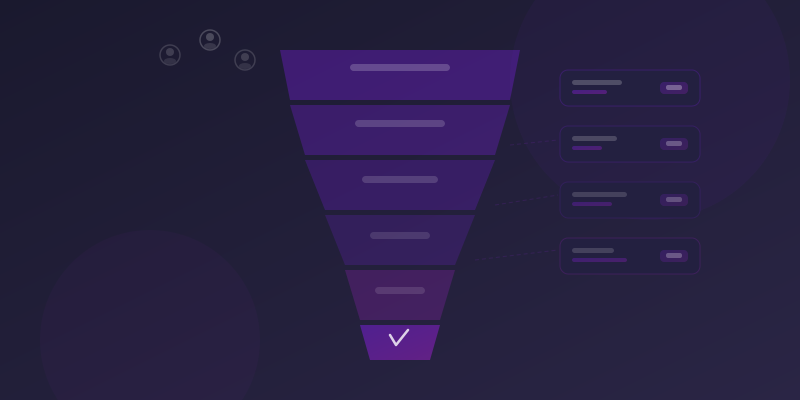
Overcomplicating your hiring pipeline is as dangerous as having none. For most growing companies, 5-7 stages cover everything you need:
1. Job Requisition and Planning
Before you post a job, align on what you actually need. Define the role, the must-have skills, the nice-to-haves, and the hiring timeline. Involve the hiring manager and at least one other stakeholder.
2. Sourcing and Job Posting
Post the job on relevant channels — your careers page, job boards, LinkedIn, and niche communities. If you are using an ATS, distribute to multiple boards from one place.
3. Application Review and Screening
Review incoming applications against your defined criteria. Use resume screening or AI-assisted scoring to focus your time on the most relevant candidates. Aim to complete screening within 48 hours.
4. Initial Interview (Phone or Video Screen)
A 20-30 minute conversation to validate basic fit: motivation, role understanding, salary expectations, and availability. This is a quick filter, not a deep dive.
5. In-Depth Interview
The main evaluation stage. Use structured questions tied to the competencies you defined in step 1. Include the hiring manager and one or two team members. For technical roles, add a skills assessment.
6. Decision and Offer
Debrief as a team using a shared scorecard. Make a decision within 24-48 hours of the final interview. Extend the offer quickly — delays lose candidates to competing offers.
7. Rejection Communication
Every candidate who is not hired deserves a timely, respectful rejection. Automate this where possible, but personalize for candidates who reached the interview stage.
Try BorovaHR Free — No Credit Card Needed
Post jobs, screen candidates with AI, and hire faster. Set up in under 10 minutes.
Get Started FreeAssigning Ownership at Every Stage
A process without owners is just a document. For each stage, someone needs to be responsible for moving candidates forward and making decisions.
Typical Ownership Model
| Stage | Owner | Responsibility |
|---|---|---|
| Job Requisition | Hiring Manager | Define role, approve job description |
| Sourcing | HR / Recruiter | Post job, manage inbound applications |
| Screening | HR / Recruiter | Review resumes, shortlist candidates |
| Phone Screen | HR / Recruiter | Conduct initial screen, pass qualified candidates |
| Interview | Hiring Manager | Lead interview, collect team feedback |
| Decision | Hiring Manager | Make final call, coordinate with HR on offer |
| Offer / Rejection | HR / Recruiter | Send offer letter, handle negotiations, notify rejected candidates |
In smaller companies, one person often covers multiple roles. That is fine — what matters is that responsibility is explicit, not assumed.
An ATS like BorovaHR makes ownership visible by assigning team members to candidates and sending automatic reminders when action is needed.
Setting Realistic Timelines
Speed matters in hiring. The best candidates are off the market in 10 days. If your process takes 6 weeks, you are consistently losing to faster competitors.
Here are target timelines for each stage:
- Application to screening response — 24-48 hours
- Screening to phone interview — 2-3 business days
- Phone interview to in-depth interview — 3-5 business days
- Final interview to decision — 1-2 business days
- Decision to offer sent — Same day or next business day
Total target: 2-3 weeks from application to offer. This is achievable for most roles if you plan interview schedules in advance and avoid unnecessary rounds.
Common Timeline Killers
- Waiting for calendar alignment — Use a scheduling tool or offer multiple time slots upfront
- Adding extra interview rounds — Every round adds 3-5 days. Only add a round if it evaluates something new
- Slow internal decision-making — Set a decision deadline before the interview starts
- Manual coordination — Use automation to schedule interviews, send reminders, and collect feedback
Try BorovaHR Free — No Credit Card Needed
Post jobs, screen candidates with AI, and hire faster. Set up in under 10 minutes.
Get Started FreeBuilding Evaluation Scorecards
Gut-feel hiring is unreliable and unfair. A scorecard turns subjective impressions into structured data that your team can discuss objectively.
What to Include in a Scorecard
- 3-5 core competencies tied to the role (e.g., technical skill, communication, problem-solving)
- A clear rating scale — 1-5 is standard. Define what each number means so everyone rates consistently
- Space for evidence — Require interviewers to note specific examples, not just scores
- An overall recommendation — Strong hire, hire, maybe, or no hire
Example Rating Definitions
| Score | Meaning |
|---|---|
| 5 | Exceptional — Among the best candidates seen for this competency |
| 4 | Strong — Clearly meets or exceeds the bar |
| 3 | Meets expectations — Adequate for the role |
| 2 | Below expectations — Gaps that would require development |
| 1 | Significant concerns — Does not meet the bar |
Collect scorecards before the debrief meeting. This prevents anchoring bias — where one loud opinion sways the group before others share their independent assessment.
How to Scale Your Hiring Process
A process built for 5 hires per year will break at 20. Here is how to scale without rebuilding from scratch:
Templatize Everything
Create templates for job descriptions, interview questions, rejection emails, and offer letters. Templates ensure consistency and save hours of rewriting.
Automate Repetitive Tasks
Use your ATS to automate:
- Application confirmation emails
- Interview scheduling and reminders
- Rejection notifications for candidates who do not pass screening
- Feedback collection from interviewers
Train Your Interviewers
As more people join the interview process, invest 30 minutes training them on your scorecards, structured questions, and how to evaluate candidates fairly. Untrained interviewers are your biggest quality risk.
Review and Improve Quarterly
Look at your hiring data every quarter: time-to-hire, offer acceptance rate, candidate drop-off by stage, and source effectiveness. Fix what is broken, keep what works.
BorovaHR gives you all of these capabilities out of the box — templates, automation, team collaboration, and reporting — so you can focus on finding great people instead of managing spreadsheets.
Try BorovaHR Free — No Credit Card Needed
Post jobs, screen candidates with AI, and hire faster. Set up in under 10 minutes.
Get Started FreeFrequently Asked Questions
How many stages should a hiring process have?
Most growing companies do well with 5-7 stages. Fewer than 4 usually means you are skipping important evaluations. More than 8 means you are adding friction that slows hiring and frustrates candidates.
How long should the hiring process take?
Aim for 2-3 weeks from application to offer for most roles. Senior or executive roles may take 4-6 weeks. Anything longer than that, and you are likely losing top candidates.
Who should own the hiring process?
The hiring manager owns the decision. HR or a recruiter owns the process — scheduling, coordination, communication, and compliance. In small companies, these may be the same person.
Do I need an ATS to have a structured process?
You can run a structured process with spreadsheets and email, but it requires significant manual effort. An ATS automates the repetitive parts and makes the process visible to your whole team. BorovaHR is free to start.
What is the biggest mistake companies make with hiring?
Skipping structure entirely and relying on informal conversations to evaluate candidates. This leads to inconsistent decisions, bias, and bad hires that cost 30-50% of the role's annual salary to fix.